
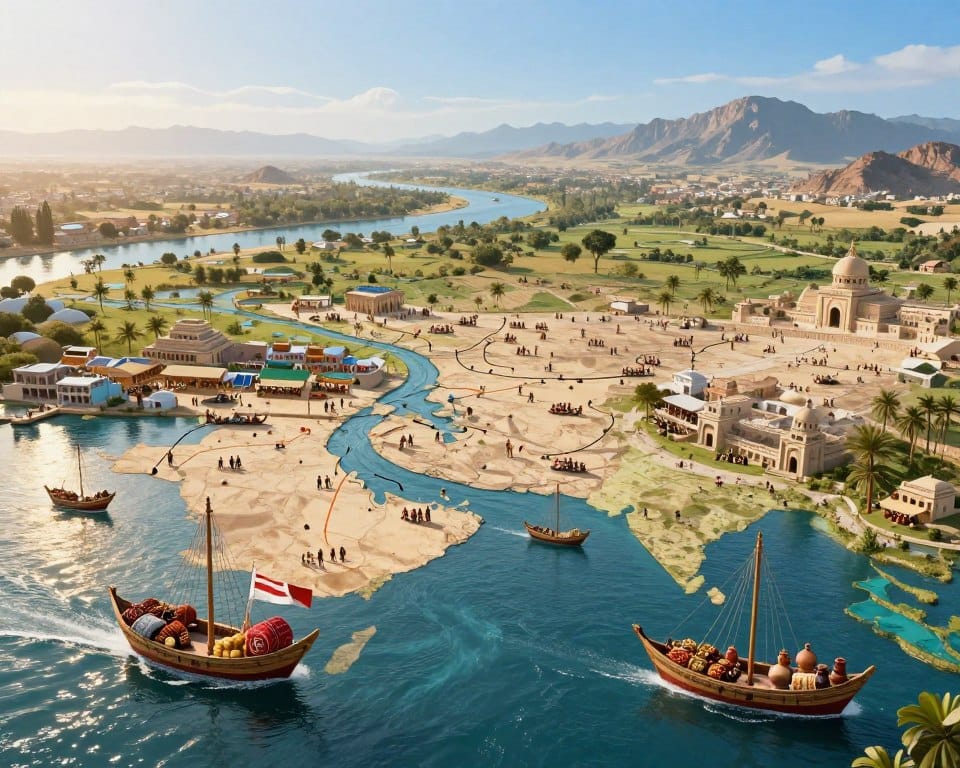
The phrase water trade routes in ancient civilizations names a network that reshaped economy and power across the early world.
Maritime corridors and river lanes cut transport costs and linked coastal cities into regional systems. Sail technology and local boats drove goods from river markets to open sea lines over long timeframes.
Archaeology, shipwreck finds, and inscriptions provide the evidence base. Case studies from the Nile, Aegean, Red Sea and Indian Ocean show how geography steered ship design and risk during each period.
This section frames the article’s scope and sets expectations. Readers can expect named ports, cargo types, dates, and clear examples that make the history actionable.
Key Takeaways
- Maritime networks lowered friction compared to overland caravans and concentrated power in ports.
- Rivers and coastal feeders were part of layered logistics that expanded reach and resilience.
- Evidence from wrecks and texts grounds claims in verifiable data.
- Specific regions like the Nile and Gibraltar Strait shaped vessel design and route choice.
- Seasonal factors such as monsoon timing played a central environmental role.
- The article will use named examples and dates to clarify how trade systems formed over time.
Why water trade routes mattered to ancient economies and power
Maritime corridors gave cities predictable, low-cost movement that reshaped local history and enabled long-term planning.
Carriage by sea cut costs and time. A Roman ship could cross the Mediterranean in about a month at a fraction of overland expense. That cheap bulk movement let producers export surplus and urban centers import specialized goods for growing populations and markets.
By 1000 BC, Phoenicians, Egyptians, and Greeks built havens that linked coasts and interiors. Harbors gathered goods from many regions and held supply until departures matched seasonal winds.
- Cheap shipping fueled surplus, urban growth, and state revenues.
- Control of chokepoints and harbors created taxation and pricing power.
- Sea legs joined caravans to form layered value chains where prices rose with handling.
- Ports served as centers for credit, information, storage, and coordination.
- Naval strength reduced risk and extended a city’s commercial reach over years.
Maritime power rested on institutions and services as much as on fleets. Customs, warehouses, pilots, and port law were a decisive part of sustained commercial advantage.
From rivers to open sea: how boats, sails, and navigation evolved over centuries
Early craft changed as demand for bulk movement rose. Simple dugouts and rafts gave communities the first load capacity. La Marmotta canoes (5700–5100 BC) show towing and heavier use at an early time.
From rafts and dugouts to sewn-plank craft and river boats
Rafts and dugouts dominated at first. Sewn-plank hulls and light timbers then increased capacity and made repairs faster. River craft adopted steering oars and stone anchors to handle seasonal flow and wind reversal.
Invention and spread of the sail
Iconography places clear sails in late fourth millennium BC Egypt. The sail spread across the eastern Mediterranean and Red Sea around 2500–2000 BC. By about 1000 BC it reached the Bay of Bengal and Island Southeast Asia.
Reading winds, stars, and shores: early navigation practices
Wayfinding relied on wind patterns, swell, cloud forms, bird flights, shoreline cues, and star risings. Better rigs reduced rowing needs and enabled longer open-sea passages when weather windows aligned.
- Adoption varied by region due to timber access and cost.
- Cumulative innovation—hull, rig, steering, anchors—matched growing trade demands.
- Practical navigation made distant voyages feasible over years and number of journeys.
| Craft | Material | Advantage |
|---|---|---|
| Raft/dugout | Log, simple lashings | Low cost, short river use |
| Sewn-plank | Light timbers, stitched seams | Repairable, higher capacity |
| Sail-equipped ships | Fabric sails, bipod masts | Extended range, less rowing |
The Nile corridor: Egypt’s highway of goods, people, and ideas
The Nile’s predictable currents and seasonal winds forged a dependable logistics spine.
Downstream loads drifted on the current. Upstream movement used sails and polite headwinds. That pattern made two-way cargo and passenger flow routine.
River to sea: Byblos ships, anchors, and Red Sea crossings
Depictions show square sails on river boat hulls by c. 3200 BC. By 2475 BC seagoing ships used bipod masts, long steering oars, and heavy stone anchors. These tools cut loss at sea and improved handling near the port.
Egypt–Levant–Punt: cedar, wine, resins, and gold moving through ports
The link with Byblos begins around 2686 BC. Fleets, including Sneferu’s, brought cedar and Levantine wine to Egyptian docks.
- Wadi Hammamat served as the overland hinge to the Red Sea for Punt expeditions.
- Punt exported gold, aromatic resins, ebony, and ivory back to Egyptian ports.
- State sponsorship scaled fleets and scheduled departures by season.
| Leg | Typical goods | Key tech |
|---|---|---|
| River | Grain, people | Square sail, boat steering oars |
| Coastal/sea | Cedar, wine, resins, gold | Bipod masts, stone anchors |
| Overland | Caravans to ports | Wadi tracks, staging sites |
Mediterranean startup zones: Aegean, island chains, and safe havens
Shallow seas and clustered isles created startup conditions for coastal commerce across the central Mediterranean.
The Aegean and northeastern Adriatic offered many havens within sight of one another. This reduced navigational risk and let small operators run frequent short hops. Costs stayed low. Capital needs stayed small.
Small boats and towed canoes moved goods from cove to cove. Over time these micro-legs aggregated into longer journeys. Pilots who knew shoals and currents made narrow passages safe. Sheltered coves and steady local winds let crews scale operations.
Local coastal circuits feeding larger networks
Fisheries and seasonal produce created regular demand. Meeting ports formed where local circuits met bigger carriers. The Adriatic’s island chain served as a stepping-stone toward Italy. That link supported exchange between eastern and central regions.
- Intervisible islands lowered risk and encouraged frequent hops.
- Towed rafts and canoes increased payloads for移migration and commerce.
- Micro-logistics—short legs, small crews—built the foundation for long-distance trading.
| Feature | Advantage | Example |
|---|---|---|
| Intervisible isles | Lower navigational risk | Aegean island hops |
| Sheltered coves | Scalable small-boat circuits | Northeastern Adriatic havens |
| Towing & rafts | Higher payloads with low capital | La Marmotta canoes |
Practical geography created entrepreneurial places where pilots, port services, and repeated schedules formed. These startups then attracted larger carriers. For more on how hubs shaped exchange, see the role of maritime hubs.
Minoans, Phoenicians, Greeks, and Romans: building Mare Nostrum’s trade web
Island hubs, merchant skill, and ship designs combined to knit the Mediterranean into a dense commercial web.
The Minoans used Crete’s central position and advanced hull forms to bind Aegean markets. Their sharp-prowed ships handled inter-island hops. Crete served as a manufacturing and redistribution center for pottery, timber, and luxury goods.
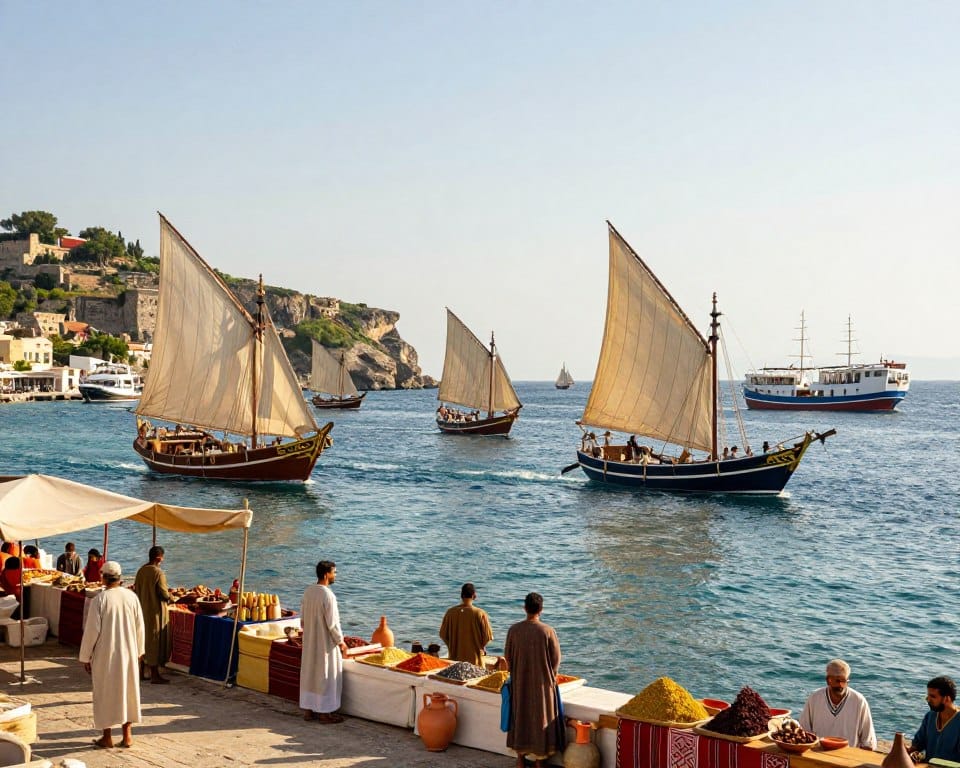
Minoan reach and shipbuilding advantages
Minoan hulls emphasized speed and maneuverability. Skilled pilots read coastal cues and kept short sea legs safe. This coherence made the Aegean a single commercial part rather than isolated markets.
Phoenician ports and westward expansion
Phoenician traders founded well-sited ports along North Africa and Iberia. Their repeatable stops, clear cargo lists, and compact ships let them move metals, dyes, and finished wares far from the Levant.
Greek island networks and inland links
Greek city-states stitched islands and shores together. Small merchant vessels connected to coastal roads. Goods moved from harbors to inland markets on pack animals and wagons.
Roman scale and standardized port systems
Rome scaled maritime movement. Fast crossings and low freight costs made grain, oil, and wine cheap to move across the sea and feed cities and armies. Standardized port administration, storage, and customs increased predictability and credit for long voyages.
- Mixed crews and shared ownership emerged by the Late Bronze Age, showing practical multinational cooperation.
- Naval protection and road-ending choices aligned maritime priorities with strategic fiscal power.
- Islands and peninsulas acted as hubs; ships carried both bulk and high-value goods to project city influence.
| Culture | Ship/Port Role | Typical Cargo Strategy |
|---|---|---|
| Minoan | Fast coastal hulls, central Crete ports | Regional redistribution, luxury pottery |
| Phoenician | Stout merchant ships, chain of trading ports | Metals, dyes, repeatable long links |
| Roman | Large bulk ships, standardized ports | Grain, oil, wine; predictable monthly crossings |
Evidence beneath the waves: shipwrecks that map ancient trade
Shipwrecks act as fixed data points that let researchers map where goods moved and how ships risked the open sea.
The Dokos wreck (c. 2200 BC) anchors early Aegean coastal activity. Uluburun (c. 1305 BC) and Gelidonya (c. 1150 BC) provide tightly dated cargo lists. Each site records dates, cargo types, and planned distribution.
Key wrecks and what they prove
- Uluburun: bronze ingots, Canaanite jars, exotic resins and ivory. These items show multi-region sourcing and long supply chains.
- Gelidonya: mixed metal loads and regional pottery. It proves coastal hubs handled both bulk staples and high-value goods.
- Dokos: early coastal loss dated to c. 2200 BC. It supports a model of frequent shore-hugging hops during this period.
- 2024 Israel deep find: a c. 1300 BC vessel 90 km offshore carrying Canaanite jars. It signals rare blue-water intent and higher navigational confidence for the Late Bronze Age.
About 1,780 wrecks have been cataloged before 1500 AD. Most lie near coasts. That concentration supports short-leg sailing and frequent port calls. Consistent amphora types and hull remains help reconstruct lanes and standard cargo practice over times.
| Wreck | Date | Key cargo |
|---|---|---|
| Dokos | c. 2200 BC | Regional pottery, early hull remains |
| Uluburun | c. 1305 BC | Bronze ingots, Canaanite jars, resins |
| Gelidonya | c. 1150 BC | Metals, mixed ceramics |
Shipwreck archaeology supplies quantitative checks on texts. Cargo lists reveal both bulk staples and luxury items, mapping supply and demand between named ports. Wreck distributions also mark hazard zones tied to weather, reefs, or piracy. For context on ports and hub behavior see the role of maritime hubs.
Together these finds build a clearer picture of past maritime systems and the vessels that served them. They change how history treats risk, specialization, and coastal connectivity.
Red Sea and Indian Ocean corridors: monsoon winds and the Periplus
Seasonal monsoon patterns turned risky open-sea legs into scheduled windows for sustained commerce. The monsoon is a predictable seasonal wind system that offered outbound and return sailing months between Egypt and India.
Alexandria’s merchants, Ptolemaic strategy, and Roman finance
Alexandria dominated Red Sea activity. Ptolemaic policy created port support and state offices to manage long-distance shipping.
Roman financiers entered Alexandria by the mid-2nd century BC. Their capital underwrote larger ships and fuller cargoes. A Ptolemaic office titled “commander of the Red and Indian Seas” appears under Ptolemy XII. That post signals organized, sustained traffic rather than ad hoc voyages.
The Periplus of the Erythraean Sea: ports, goods, and seasonal sailing
The Periplus (c. 40 AD) reads like a pragmatic pilot-book. It lists ports, customs, goods, and the monsoon schedules pilots used to plan departures and returns.
- It names port calls and local duties.
- It records typical goods: spices, aromatics, fine textiles, ivory, and precious metals.
- It shows direct ocean legs overtaking longer coastal chains after monsoon adoption.
Monsoon navigation unlocking direct Egypt–India trading
Predictable winds reduced uncertainty. Ships left Alexandria timed to catch the outbound monsoon and returned on the reversal. That pattern cut voyage time and costs.
Ptolemaic ports, Roman capital, and skilled pilots combined to scale direct crossings. Political actions by Augustus altered Arabian port hierarchies and customs. The result was fewer intermediaries and larger cargoes per ship.
| Feature | Impact | Example |
|---|---|---|
| Monsoon windows | Reliable outbound/return schedule | Direct Egypt–India voyages |
| State office | Centralized oversight and protection | Commander of the Red and Indian Seas |
| Pilot-book | Standardized port calls and timing | The Periplus (c. 40 AD) |
Nabataean control points: Aila and Leuce Come on the Red Sea
Where sea met sand, Nabataean governance turned harbors into guarded revenue hubs.
The kingdom ran Aila at the head of the Gulf of Aqaba and held Leuce Come on the Red Sea. A customs post, fort, and a paved road to Petra linked the port to the city market. Luxury goods paid a fixed 25% levy. Garrisons enforced collection and security.
Customs, forts, and caravan roads to Petra
The Aila–Petra road moved goods quickly to inland demand. Caravans timed departures to ship arrivals. That cut idle days and reduced theft on desert land stretches.
Hazards of the Gulf of Aqaba and boat design implications
Strabo records a 15-day voyage to Leuce Come and losses from reefs and foul winds. Reefs punished square-rigged craft. Lateen-like rigs on dhow-style vessels tacked better against prevailing NW winds in Aqaba. Vessels with fore-and-aft sails could close windward and survive narrow coast passages.
- Customs posts, forts, and roads converted ports into steady revenue nodes.
- High duties drew traders despite alternatives because Petra offered strong demand and secure markets.
- Boat design and coastal geometry directly shaped which vessels worked those legs.
| Feature | Effect | Example |
|---|---|---|
| 25% customs | High revenue, centralized flows | Aila collections to Petra |
| Garrisons | Secure passage, deterred theft | Fortified port posts |
| Lateen-like rigs | Better windward ability | Dhow-style vessels in Gulf |
water trade routes in ancient civilizations: defining patterns across regions
Patterns of coastal hops and open-ocean leaps define how goods actually moved across old maritime networks. This synthesis offers a reusable framework for reading any map or claim about past exchange.
Coast-hugging vs. blue-water passages
Coast-hugging means short legs between safe havens. Frequent anchoring, local pilots, and small craft dominate this model.
Blue-water passages are long out-of-sight transits. They rely on steady winds, stronger rigs, and larger crews.
Ports, havens, and transshipment hubs as control nodes
Hubs concentrated customs, storage, finance, and information. A favored port could shape schedules and prices. Mixed chains of small coastal boats and larger carriers formed most actual movement. Land segments then linked rivers, deserts, and roads to those hubs.
- Read maps as areas of influence, not single lines
- Check wind seasonality, shelter frequency, currents, reef lines, and political control
- Expect mixed ownership and multinational crews on many vessels
| Model | Key feature | Operational effect |
|---|---|---|
| Coast-hugging | Short sheltered legs | Low risk, frequent handoffs |
| Blue-water | Long direct crossings | Faster long-distance moves, higher ship risk |
| Transshipment hub | Storage, customs, finance | Price control, scheduling power |
Adriatic connectors: the Cetina network linking islands and Italy
A narrow maritime web off Dalmatia tied river mouths, isles, and mainland markets through frequent short crossings.
The Cetina base sat beside a river mouth near modern Split. That position faced a chain of islands and short sea gaps that small boats could cross regularly. Manageable legs reduced exposure and let crews keep schedules.
Small craft, eclectic cargoes, and early Adriatic–central Med ties
Archaeological finds show broad contacts. Faience necklaces, ostrich-shell and fish-bone tools, copper daggers and axes, and bossed bone plaques appear across Sicily, Malta, southern Greece, and Italy.
- Base placement: river mouth facing island chains that made short legs feasible
- Typical goods: faience jewelry, ostrich-shell objects, copper weapons, carved bone plaques
- Operational logic: frequent stops and short hauls let modest boats create reliable schedules and social ties
Artifact distributions map repeated movements over years rather than one-off voyages. Engravings at Tarxien may even depict the small ships used. The web linked Adriatic nodes to central Mediterranean markets earlier than often assumed.
| Feature | Evidence | Effect |
|---|---|---|
| Geography | Many anchorages, island sightlines | Short gaps, lower exposure |
| Cargo mix | Faience, ostrich shell, copper, bone plaques | Reciprocal demand between islands and land markets |
| Longevity | Widespread finds, repeated contexts | Sustained exchange over years until early 2nd millennium BC |
The Cetina web also fed inland land corridors. Imported items moved from shore to interior markets by pack animals and river tracks. The network faded as stronger polities and new vessel types rearranged preferred ports and schedules.
Across the Gibraltar Strait: Neolithic links between Iberia and North Africa
Small crossings across the Gibraltar Strait connected Iberian shores and North Africa by steady, visible sea links. Communities used short hops to move people, crops, and craft knowledge without deep-water ships. This geography favored repeat contact over single epic voyages.
Archaeology shows matching farming packages at Oued Beht (c. 3400–2900 BC) and Iberian sites. Pottery styles align with Perdigoes and La Loma. North African ivory and ostrich shell appear at Valencina and Los Millares, signaling repeated exchange of goods rather than chance items.
Genomes add confirmation. Southern Iberian populations carry hunter-gatherer, Neolithic farmer, and Saharan pastoralist ancestry. An African-descended individual at Camino de las Yeseras shows mobility across the sea and links between places and land paths.
Chosen landing spots likely offered shelter, fresh water, and quick access to inland tracks. Small boats and intervisible coasts made seasonal crossing routine. Together, artifacts, pottery parallels, and genetics build a consistent picture of durable maritime contact across this region.
| Evidence | What it shows | Implication for contact |
|---|---|---|
| Oued Beht (c. 3400–2900 years BC) | Full Neolithic farming package | Shared crops and livestock with Iberia |
| Ivory & ostrich shell finds | Valencina, Los Millares | Repeated import of North African goods |
| Pottery parallels | Perdigoes, La Loma styles | Shared techniques and aesthetic exchange |
| Ancient genomes | Mixed Iberian and Saharan ancestry | Regular human mobility across the strait |
Ships and sails: what vessel types tell us about routes and risk
Hull form and sail plan often dictated whether a link hugged the shore or cut a long course across open water.
Egyptian river craft used steering oars for fine control. Iconography shows stern-mounted rudders by about 1420 BC on larger hulls. Stone anchors and bipod masts added hold and stability for coastal legs.
Stern rudders, steering oars, and rig choices along coasts and rivers
Steering oars fit shallow, flexible hulls on rivers and tight harbors. Stern rudders worked better on larger, deeper vessels for open-legs. Square sails pushed fast downwind runs. Lateen rigs let small craft beat to windward along a coast.
Why lateen and dhow-like craft excelled in the Red Sea
In narrow gulfs and headwinds, dhow-style lateen rigs outperformed square rigs. That advantage lowered wreck risk near reefs and lee shores. Stone anchor mass and shape helped hold position on rocky bottoms common along those coasts.
- Steering oar vs rudder: oars for agility, rudders for steady course on bigger hulls
- Square sails: best for downwind bulk runs; lateen: superior windward work
- Anchor weight and fluke shape determine holding power on sand, rock, or weed
- Vessel size and number reflect port depth, cargo type, and predictable seasonal windows
- Wider beams carried staple goods; lighter builds moved high-value cargo on tight schedules
| Feature | Effect | Example |
|---|---|---|
| Rudder or oar | Steering control | Egyptian river and seagoing craft |
| Rig type | Windward ability vs downwind speed | Lateen/dhow in the Red Sea |
| Anchor design | Holding power near reefs | Stone anchors, bipod masts |
Design choices cut risk and kept schedules. Vessels that matched wind regimes preserved time and margins. That alignment drove which goods moved where and when.
Markets, goods, and margins: how value increased from port to hinterland
A single shipment gained value as it passed from ship deck to wharf, warehouse, and caravan.
Bulk staples moved by sea at low per-unit cost. Luxury items followed different rhythms. Metals, wine, and oil traveled on slow regular sailings. Spices, resins, and fine ceramics moved faster and earned higher markups.
Caravan handoffs, tolls, and the layered cost of distance
Every handling step added fees and risk premiums. Unloading required labor. Storage demanded space and watchmen. Guards and customs raised the price further.
Inland cities paid for scarcity and effort. Middlemen captured margins at each handoff. Credit arrangements and joint ventures spread losses and profits across shipowners, merchants, and caravan leaders.
- Time-sensitive goods paid for speed and fewer handoffs.
- Bulk cargoes maximized volume and lower per-unit margins.
- Predictable port services and warehousing let traders optimize departure windows.
| Step | Typical cost added | Who benefits |
|---|---|---|
| Unloading & labor | 5–10% of consignment value | Wharf workers, stevedores |
| Storage & insurance | 3–8% per month | Warehouse owners, financiers |
| Customs & tolls | 5–25% depending on port | Authorities, port officials |
| Caravan transfer & inland haul | 10–40% by distance and terrain | Caravan leaders, drovers |
A typical route ran: port berth → customs yard → bonded warehouse → caravan staging → inland market. Authorities favored choke points for revenue and security. That pattern made integrated sea–land planning more profitable than isolated legs.
For how ports shaped broader hub behavior, see the role of maritime hubs.
Areas of influence, not single lines: reading ancient trade maps correctly
Maps often simplify complex channels into single arrows that hide seasonal, political, and logistical choices.
Arrows mark direction, not the many choices mariners faced. Shelter, currents, and seasonal winds shaped daily decisions. Political permits and port duties altered whether a vessel stopped or bypassed a harbor.
Goods usually moved by multiple vessels and hands. A Late Bronze Age cargo might shift from a coastal boat to a larger carrier then to a land caravan. Ownership and crew were often multinational, so voyages did not follow one fixed route or company plan.
How to read maps the practical way
- Assume arrows show direction only; ask what shelters and wind windows lie nearby.
- Visualize layered journeys: local boats, mid-sea carriers, and overland legs.
- Treat marked locations as influence hubs whose reach changes by season and security.
- Compare wreck clusters, inscriptions, and port remains to spot high-probability links.
- Overlay physical constraints, weather calendars, port services, and land connections to form a working model.
| Map element | What it masks | How to test |
|---|---|---|
| Arrow | Intermediate stops and shelter choices | Check wreck and harbor evidence |
| Line | Seasonal wind windows and staggered departures | Compare sailing season records and pilot books |
| Hub dot | Variable reach by time and polity | Examine customs, garrisons, and storage remains |
Read maps as zones of influence rather than single highways. That model better fits the historical record and helps reconstruct how goods, crews, and capital actually moved through sea and land.
Global echoes: Austronesian seafaring as a comparative lens
Austronesian voyaging shows how island density and craft design shape sustained long-distance exchange.
Catamarans, outriggers, and star-path navigation across islands
From about 3000–1500 BC, Austronesian mariners used catamarans, outrigger hulls, and crab-claw or tanja sails to span the Indo-Pacific. They reached Madagascar and the far Pacific across predictable seasonal patterns.

Outriggers and catamarans traded speed for stability. That made longer crossings safer than single-hull designs alone. Star-path navigation tied rising and setting stars to fixed headings. Pilots taught these methods as a systematic skill.
- Dense island chains generate low-risk startup conditions, similar to the Aegean but on a larger scale.
- Durable boat and sail forms matched prevailing swell and wind over many years.
- Networks layered local hops and open-sea legs, creating steady demand for goods and prestige items.
| Feature | Austronesian | Mediterranean |
|---|---|---|
| Hull forms | Outrigger, catamaran | Single-hull, sewn-plank |
| Navigation | Star-path, swell cues | Coastal pilots, stars near shore |
| Operational scale | Open-ocean spanning islands | Short coastal hops and hub links |
Comparing these systems shows a clear point. Environment drives design. Design then shapes the scale and rhythm of trade and trading across seas and islands around the world.
What these routes teach us about today’s environmental challenges
Seasonal wind wisdom from old mariners can inform how ports schedule and manage risk today. Patterns of timing, shelter, and layered links made past systems both efficient and resilient.
Ports, coasts, and climate: lessons from monsoon timing and safe havens
Monsoon timing shows the value of predictable seasonal planning. Alexandria and Red Sea pilots timed departures to reduce loss and idle time. Modern operations can map seasonal risk windows and set fixed sailing calendars.
Safe havens reduced exposure to storms. Nabataean harbors and small anchorages acted as failover nodes. Today, distributed coast networks of ports and anchorages offer the same protection.
Resilience, redundancy, and diversified routes under changing seas
Roman logistics used multiple hubs so a single city closure did not stop flows. Diversified routing and staged handoffs sustained commerce when one port faltered. Planners should design modular corridors that let ships divert without major delay.
- Use seasonal forecasts to set departure and arrival time windows.
- Build a distributed network of ports and anchorages for safe failover.
- Design vessel types and cargo mixes that match local wind and hazard profiles.
- Prioritize port services—pilots, salvage, repair, storage—as core resilience assets.
- Create clear customs rules to cut idling and emissions from delays.
- Deploy real-time environmental monitoring to reduce weather losses.
| Ancient lesson | Modern application | Benefit |
|---|---|---|
| Monsoon-timed departures (Red Sea) | Seasonal scheduling and forecast-based slots | Fewer delays, lower fuel use |
| Distributed safe havens (Nabataean ports) | Networked small ports and anchorages | Operational failover during storms |
| Diversified hubs (Roman model) | Multiple regional port nodes and transshipment | Supply continuity when one city is disrupted |
| Port services as infrastructure | Invest in pilots, salvage, storage, repair | Reduced loss, faster recovery |
Resilient maritime systems blend environmental intelligence with modular sea–land segments. That mix turns seasonal risk into manageable planning and keeps goods moving despite shocks.
Conclusion
Conclusion
A clear pattern ties maritime practice to lasting economic power. This history shows layered networks, seasonal timing, and port services turned geography into reliable movement.
Ship technology, anchors, and rigs matched environments to extend safe range. Wrecks, inscriptions, and harbor remains provide the evidence that supports practical sailing logic and seasonal calendars.
Port hubs created areas of influence rather than single lines. That model explains how goods, crews, and capital flowed across the sea and shaped city power over time.
Lessons for the present are direct. Plan redundancy. Fit designs to local hazards. Invest in pilots, storage, and repair. These steps help the wider world move toward resilient, low-impact systems at the end.